Summary
Was New York actually cheaper to live in back in 1900? At first glance it looks that way. Rent was around $10–$14 a month, bread cost a nickel, and eggs were about twenty cents a dozen. Sounds great. But what was the reality?
Rent in 1900: Cheap on Paper, Hard in Reality
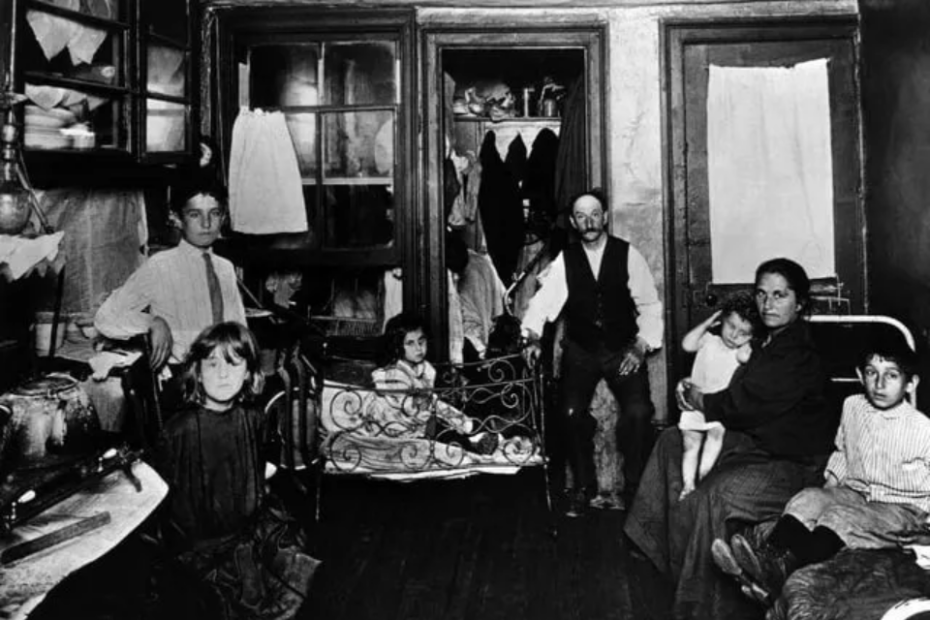
At the beginning of the twentieth century, many working-class New Yorkers lived in tenement buildings in neighborhoods like the Lower East Side. These apartments were small and often poorly ventilated. Bathrooms were frequently shared with other tenants in the hallway or courtyard.
A typical tenement apartment rented for about $10 to $14 per month around 1900. Adjusted for inflation, that is roughly $400 to $500 in today’s money.
But those apartments were crowded. Families often squeezed six to ten people into a few small rooms, and taking in boarders was common because it helped cover the rent. (You can read more about who built the tenements and why in our related article.)
Reformers like Jacob Riis documented these conditions in his famous book How the Other Half Lives, showing Americans how difficult life in the tenement districts could be.
Wages in 1900
The real challenge for many families was not just rent, but wages.
Typical weekly pay in New York around 1900 looked something like this:
- Garment worker $6–$10
- Factory laborer $8–$12
- Skilled tradesman $12–$18
That meant a typical worker might earn around $35 to $45 per month, assuming steady employment.
With rent costing roughly $12 per month, housing alone could consume about one-third of a family’s income. For families relying on a single wage earner, that left little money for food, clothing, fuel, healthcare or other necessities.
Many households depended on multiple incomes. Teenagers often worked in factories or shops, and in many cases younger children contributed wages as “newsies,” shoe shiners, deliveries, errands, etc.
How Long Did New Yorkers Have to Work to Pay the Rent?
One way to understand the cost of living is to ask a simple question: how many hours of work did it take to pay the rent?
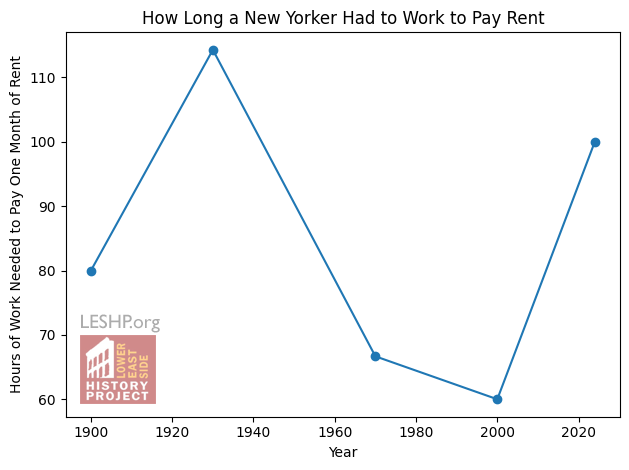
The chart shows how the relationship between wages and housing costs has changed over time.
Around 1900, a worker might need roughly 80 hours of labor to pay one month of rent. That was already a significant share of a person’s working life.
In the 1930s, the number rose sharply to more than 110 hours. This spike reflects the economic devastation of the Great Depression, when unemployment soared and wages fell.
After WWII, the situation improved. Unionized jobs, manufacturing employment, and rent regulations helped keep housing costs relatively stable compared with wages. Workers needed fewer hours of labor to pay rent than they had earlier in the century.
In recent decades however, the number has climbed again. Rising housing prices and limited housing supply, partially due to an increase in international investment and “gentrification,” have pushed rents upward faster than many wages, increasing the amount of work needed to afford housing.
What Everyday Food Cost
Food prices around 1900 also appear extremely low by modern standards. Typical food prices in New York around 1900 included:
- Bread: 5¢ per loaf
- Eggs: 20–25¢ per dozen
- Butter: 25¢ per pound
- Steak: 15–20¢ per pound
- Milk: about 6–8¢ per quart
- Sugar: about 5¢ per pound
But wages were also low. A laborer earning about ten cents an hour might need to work half an hour to buy a loaf of bread.
Many working class families cooked simple, filling meals that could feed large families cheaply, like soups and stews. Potatoes and bread formed the backbone of daily diets in working class neighborhoods like the Lower East Side.
How Much of Your Income Went to Rent?
Another way to compare the past and present is to look at how much of a household’s income went toward housing.
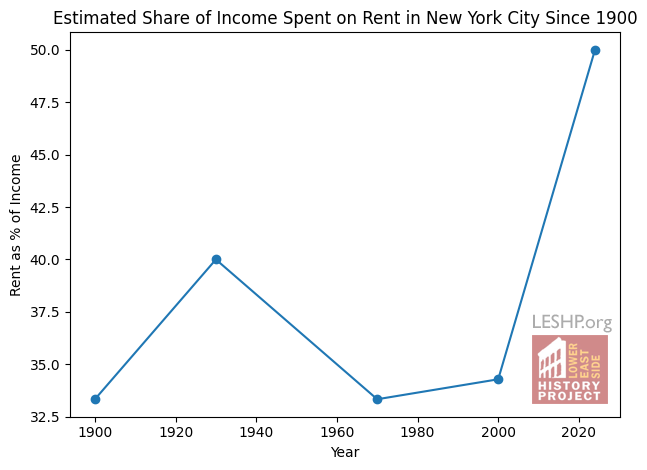
Around 1900, many working-class families spent roughly one-third of their income on rent. That was already considered a heavy burden.
During the Great Depression, incomes fell dramatically while rents did not drop as quickly. As a result, housing costs rose to roughly 40 percent of income for many households.
The situation improved in the mid-twentieth century as industrial jobs, rising wages, and rent regulation helped stabilize housing costs relative to income. So by the 1960s and 1970s the percentage fell to about one-third of their income on rent.
In recent decades, however, housing costs have risen faster than wages for many workers. Today, many renters in New York spend half of their income or more on housing, a level that economists often consider financially unsustainable.
Is New York More Expensive Today?
Yes and no.
Housing today costs far more in absolute terms, and rents have risen faster than wages for many workers. But living standards have also improved dramatically. Modern apartments typically include private bathrooms, electricity, reliable heating, and safety regulations that did not exist in most tenement buildings in 1900.
However, food is also more affordable relative to income than it was a century ago, thanks to advances in agriculture and transportation.
The Bottom Line
Looking at old prices alone can make the past seem cheaper than it really was.
In 1900, New Yorkers paid less money for rent and food, but they often lived in crowded housing with limited sanitation and unstable wages.
Today, residents generally enjoy far higher living standards, but housing costs consume a large share of income for many households.
The reality is that New York has never been an inexpensive place to live. What has changed over time is how the burden of that cost shows up in people’s lives.

Eric is a 4th generation Lower East Sider, professional NYC history author, movie & TV consultant, and founder of Lower East Side History Project.
I love this