
 This article is adapted from the upcoming book People vs. Power: The Real Estate Battles That Shaped New York City by LESHP founder, Eric Ferrara. The book examines historic land use and development conflicts across the Five Boroughs, focusing on how communities responded to major planning decisions. COMING SOON!
The People: Preservationists, federal officials, historians, civic reformers
The Power: Robert Moses, the Triborough Bridge and Tunnel Authority, City Hall allies
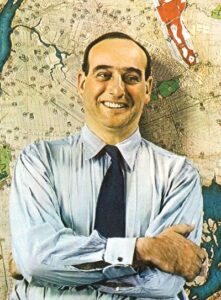
In 1939, New York City traffic parylized the streets, a daily frustration for thousands. Getting between Manhattan and Brooklyn felt like an endless crawl. (Wait, nothing changed!) Robert Moses saw this problem clearly. He held two powerful jobs: Commissioner of Parks for New York City and, critically, Chairman of the Triborough Bridge and Tunnel Authority (TBTA). Moses had a reputation for building big things, fast. His solution for the Brooklyn-Manhattan bottleneck was characteristically massive: a bridge.
This wasn’t a modest proposal. Moses envisioned six lanes of traffic suspended high above the harbor. The plan called for it to start at Battery Park, right on Manhattan’s southern tip, and stretch across to Red Hook in Brooklyn. Engineers from the firm Madigan-Hyland drew up the specifics. Their blueprints showed a structure climbing 150 feet from the water’s surface. Moses argued this bridge was the smart choice financially: $41 million dollars (a huge sum then, equal to about $800 million now) seemed cheaper and quicker than digging a tunnel. He pointed out how neatly it would link into the city’s growing network of roadways, especially the West Side Highway and the East River Drive (later renamed the FDR Drive). He wanted it finished by 1941.
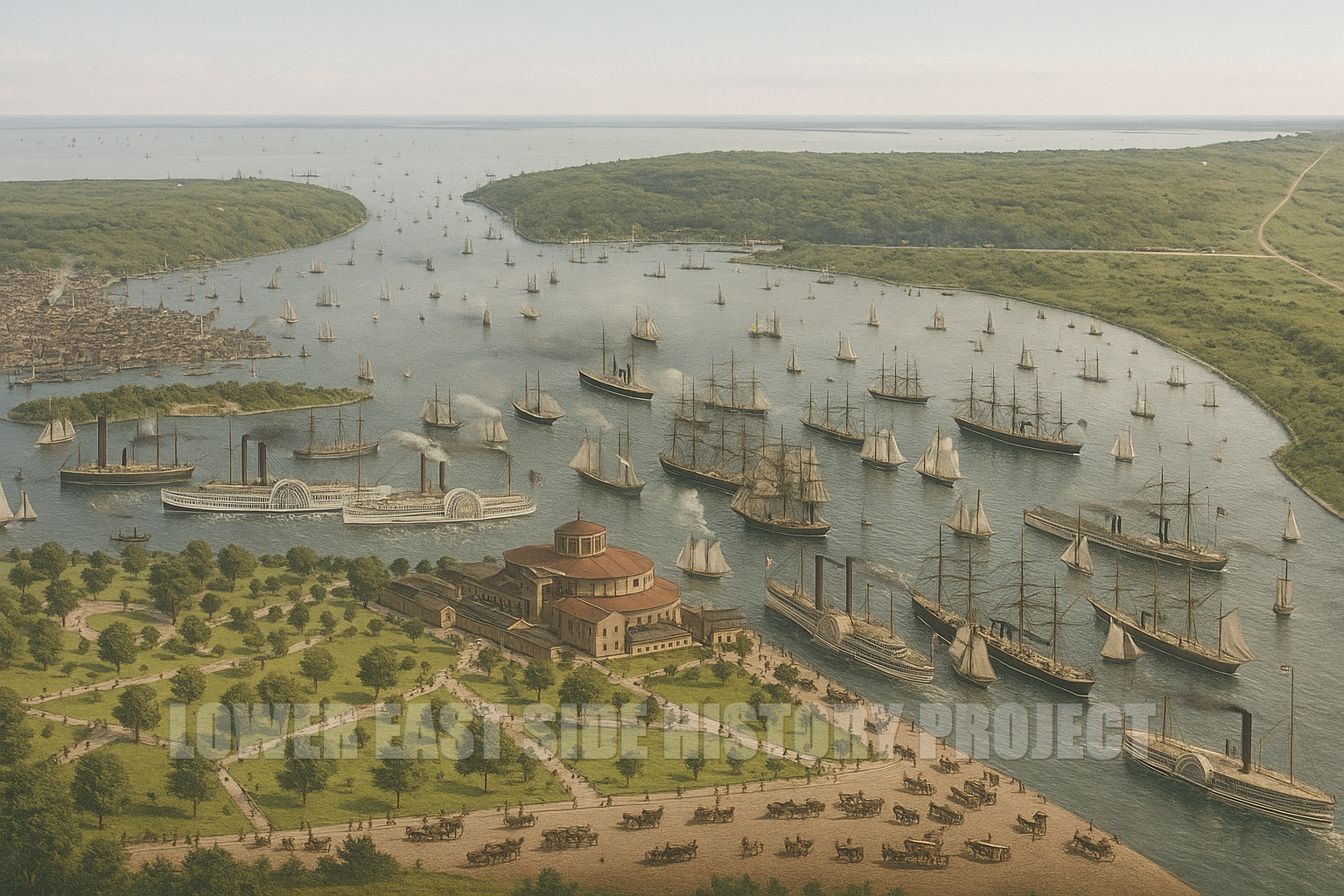
But this grand plan demanded a heavy sacrifice. To build the Manhattan landing, Castle Clinton had to go.Understanding why this caused such an uproar means knowing what Castle Clinton was. It wasn’t some forgotten shed. Built as a circular stone fort between 1808 and 1811, it originally guarded the harbor entrance. By the late 1930s, filled land had made it part of Battery Park. More importantly, since 1896, it housed the New York Aquarium, run by the New York Zoological Society. This place wasn’t obscure. Records proved over a million people walked through its doors every year – families, students, visitors from out of town. It was a genuine city institution. Its spot inside Battery Park made it even more valuable; this park offered rare open space and greenery in the crowded downtown area. Knocking down both this historic fort and the popular aquarium inside a beloved park struck many people as a terrible bargain, trading away heritage and public enjoyment just to move more cars.
The bridge’s sheer size triggered a major legal hurdle. Because it would cross water used by large ships and navy vessels, the U.S. government had to approve it. The agency in charge was the War Department (what we now call the Department of Defense). Their main job was keeping shipping lanes clear, especially for critical spots like the nearby Brooklyn Navy Yard. Moses sent his first application in 1939. The War Department looked it over carefully, focusing on practical military and shipping needs. Their answer was a firm “no.” The reason centered on height. That 150-foot clearance simply wasn’t enough. Navy experts insisted modern warships, especially the big battleships and aircraft carriers built or fixed at the Navy Yard, needed much more room above the waterline. Companies moving cargo also worried about their largest ships fitting underneath. The bridge, as planned, was labeled an “unacceptable obstruction.”
Moses wasn’t the type to quit after one setback. He pushed for revised plans, though the fundamental height problem near the Navy Yard remained difficult. With backing from Mayor Fiorello LaGuardia and other influential city figures, Moses sent the revised Brooklyn-Battery Bridge proposal back to the War Department in October 1939.
The Resistance Begins
Moses’s persistence, however, only made the opposition stronger and better organized. What started as local concern grew into a powerful alliance with friends in Washington. Leading the charge against Moses in the federal government was Harold L. Ickes, the U.S. Secretary of the Interior under President Franklin D. Roosevelt. Ickes was known for caring deeply about conservation and his department managed national parks and historic places. He saw Castle Clinton as important not just to New York, but to the whole country. He stepped in forcefully. In a letter sent directly to Robert Moses, dated January 9, 1940, Ickes made his position crystal clear: “The destruction of Castle Clinton would be a grievous loss to the city and nation, as it stands as a monument to our early history and a gateway to New York Harbor.” He framed the fort as a living piece of the nation’s beginnings, a key landmark for America’s busiest port. Ickes’s opposition mattered greatly inside the Roosevelt White House.
At the same time, the threat to the aquarium stirred another significant voice. Dr. Henry Fairfield Osborn, the well-regarded president of the New York Zoological Society (which ran the aquarium), took his fight to the newspapers. On February 15, 1940, The New York Times printed a letter from Osborn. He went beyond visitor numbers to stress the aquarium’s core purpose: “The aquarium at Castle Clinton is one of the most visited marine institutions in the country. Its loss would deprive millions of an invaluable educational resource.” This highlighted the bridge’s cost in terms of learning and science, appealing to a broad sense of what the city should value.
Organized groups within New York City itself ramped up their fight. Albert S. Bard became a leading voice. Bard was a prominent lawyer, deeply committed to preservation, and importantly, the author of the Bard Act – the law that would later form the foundation of New York City’s rules protecting historic landmarks. Bard brought serious legal and historical weight to the opposition. He gave formal testimony before the War Department, arguing strongly against the bridge’s justification. His words captured the heart of the preservation argument: “Castle Clinton is not merely a building; it is a symbol of New York’s heritage, and its destruction for a bridge is unjustifiable.” This idea lifted the fort beyond bricks and mortar to represent the city’s very identity and story.
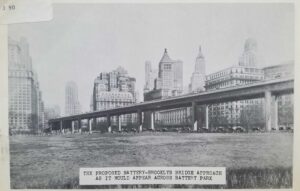
Major institutions added their disapproval. The New York Times, a powerful voice in the city at the time, ran a strong editorial on January 28, 1940, titled “Preserve Our Historic Battery Park.” The editorial voiced fears about how the bridge would change the city: it would “obliterate a cherished public park and the historic Castle Clinton, degrading the natural beauty and civic pride of New York Harbor.” Groups like the City Club of New York, focused on good government and civic improvement, made official statements against the bridge. The Municipal Art Society, dedicated to city design and saving old buildings, was especially vocal. Their 1940 report gave a grim view: “The proposed Brooklyn–Battery Bridge would irreparably harm the scenic and historic qualities of Lower Manhattan’s waterfront.” They stressed the permanent, negative visual impact the bridge would have on one of the city’s most famous and history-filled areas.
Ordinary citizens, hearing these arguments from leaders and groups, increasingly opposed the project, and The Municipal Art Society organized a petition drive. It collected thousands of names from concerned New Yorkers in just weeks, showing clear public backing for saving the site instead of building Moses’s bridge.
Faced with this powerful combination – federal opposition led by Ickes, strong arguments from people like Bard, official rejection from civic groups and the press, and clear public dislike shown by the petitions – the War Department didn’t budge. In January 1940, soon after Ickes’s public letter and the Times editorial, the Department repeated its earlier decision. Their official statement stuck to the navigation issue as the main concern: “The proposed structure poses an unacceptable obstruction to military and commercial navigation in the port of New York.” This wasn’t decided alone. President Roosevelt’s administration, aware of Moses’s sometimes forceful methods and increasingly focused on national defense as war approached in Europe, supported the War Department. They viewed the navigation problem as real and important, and saw the preservation arguments as serving the wider public good. As The Washington Post noted on February 3, 1940, the federal stance was clear: “Federal officials reject Brooklyn–Battery Bridge, citing defense and preservation concerns.”
Seeing this opposition was too strong to defeat, Robert Moses officially dropped the Brooklyn-Battery Bridge plan in March 1940. The fight against the bridge was over.

The need for a connection between Brooklyn and the Battery, however, hadn’t disappeared. Everyone quickly turned to the other option Moses had earlier dismissed: a tunnel. Digging under the harbor was a tough engineering job, but it avoided wrecking Castle Clinton and didn’t block ships. A famous tunnel expert Ole Singstad got the job of designing the Brooklyn-Battery Tunnel. Work actually started in 1941. But then, the United States entered World War II. Suddenly, materials and workers became scarce. The war caused long delays. Despite the stoppage, the project didn’t die. When the tunnel finally opened for traffic in 1950, it did what was originally needed: it connected Brooklyn and Lower Manhattan for vehicles. Importantly, it did this without wrecking Battery Park or Castle Clinton, meeting the key demand of those who fought to save them.
The solution wasn’t perfect for the aquarium. With the bridge gone but tunnel work starting (and likely knowing changes were coming to the Battery), the New York Aquarium at Castle Clinton shut down in 1941. The fish and displays were moved elsewhere. The institution found a permanent new home in 1957 when a much bigger, modern New York Aquarium opened at Coney Island in Brooklyn. Castle Clinton itself, saved from the wrecking ball, started a new life. Recognizing the history preserved through this fight, the federal government made Castle Clinton a National Monument in 1946, putting it under the care of the National Park Service.
Comparing the Plans: Bridge Vision vs. Tunnel Reality
Two solutions were considered. Here’s how they stacked up:
-
The Bridge That Wasn’t Built:
-
Price Tag (1939): $41 million.
-
Height Over Water: 150 feet (War Dept. said too low).
-
Design: Six-lane suspension bridge.
-
Road Links: Planned direct hookups to West Side Elevated Highway and East River Drive (FDR Drive).
-
Schedule: Hoped to finish by 1941.
-
-
The Tunnel That Got Built:
-
Final Cost: Roughly $80 million (much higher than the bridge guess, heavily impacted by wartime price increases and delays).
-
Distance: About 9,117 feet (roughly 1.7 miles) – making it the longest continuous underwater car tunnel in North America back then.
-
Structure: Two tubes built under the harbor floor. Each tube handled two traffic lanes.
-
Result: Opened May 25, 1950.
-
Winner?
The People – a wide group including determined preservationists (like Albert S. Bard), powerful federal figures (led by Secretary Harold L. Ickes), historians, civic activists (from groups like the City Club and Municipal Art Society), and regular citizens who spoke up.

Eric is a 4th generation Lower East Sider, professional NYC history author, movie & TV consultant, and founder of Lower East Side History Project.