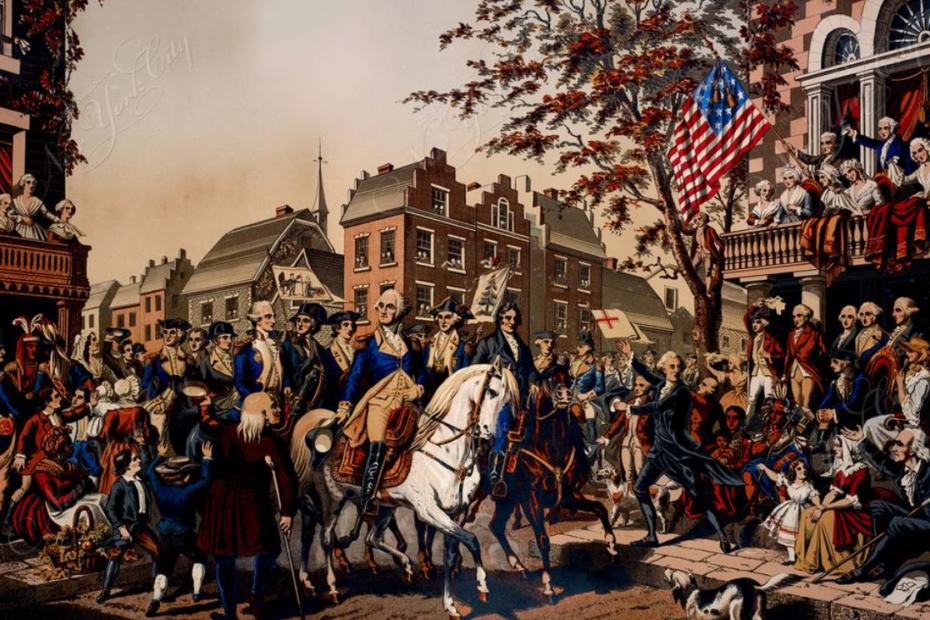
Most people who walk through the trendy streets of today’s Lower East Side have no reason to think about farms. But that is what almost all of this land was for most of its modern, post-colonial history: a patchwork of Dutch and English bouweries, marshland, and a few hills, sitting just outside the wall that gave Wall Street its name. The land north of that wall was first organized by the Dutch West India Company into a set of large farms, or “bouweries,” laid out along a Native American footpath that ran north out of the settlement. In 1651, Peter Stuyvesant, the director-general of the colony, purchased the northernmost and largest of these farms from the company and added to it by buying adjacent land, eventually controlling about 120 acres; after his term ended in 1664 he spent the rest of his life there, and when he died in 1672 he was buried in the family chapel that later became St. Mark’s Church in-the-Bowery, while the road connecting his farm to the city kept its Dutch name in anglicized form, which is why a street with nothing rural about it today is still called the Bowery.
South and east of the Stuyvesant land, other families staked out their own bouweries: Harmanus Rutgers, descended from a brewing family that had come to New Amsterdam in 1636, bought 56 acres around 1728, with the original farmhouse standing just off the Bowery, and his descendants would lend their name to Rutgers Street and, eventually, to Rutgers University, while east of his land sat the much larger holding of James De Lancey, a member of one of the city’s wealthiest merchant families and, by mid-century, the colony’s chief justice, whose roughly 300-acre estate stretched from the Bowery toward the East River.
A little further to the south of the island, the patch of ground that is now City Hall Park had a different role entirely. Under Dutch rule it was known simply as the Commons, used as a pasture, a parade ground, and a general gathering place, and by the 1730s (the British took control in 1664) the city had built a publicly funded almshouse there to house the sick and the poor, later adding a debtors’ prison known as the New Gaol along with soldiers’ barracks.
The Commons becomes a battleground of ideas
In the years leading up to the war, the Commons turned into the city’s main stage for political conflict. British troops had been present in New York in small numbers since the English took the colony from the Dutch in 1664, but the garrison that mattered for this story arrived after the French and Indian War ended in 1763, when Britain decided to keep a standing army in the colonies, partly to defend the territory it had just won from France and partly to assert authority over the colonies generally.
New York, as a major port and administrative center, was a natural place to billet soldiers, and Parliament’s Quartering Act of 1765 required colonial assemblies to help pay for housing and supplying them, a financial and political burden that many New Yorkers resented. Those troops were given barracks on the Commons, and it was that garrison, not yet a wartime invasion force, that clashed with New Yorkers over the years that followed.
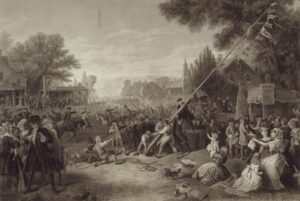
When Parliament passed the Stamp Act in 1765, New Yorkers gathered there to protest, and the following year a group calling themselves the Sons of Liberty raised the first of what would become a series of Liberty Poles outside the army barracks. British troops cut the poles down again and again, and patriots kept putting new ones up. The pole raised in 1767 to protest the Townshend Act was sawed down by soldiers in January 1770, and the fight that followed spilled onto nearby Golden Hill, a clash remembered today only in the name of Gold Street. Some argue that this incident may be the first bloodshed of the Revolutionary War, as it predated the Boston Massacre.
The Revolution was as much a civil war as a war of independence
While the conflict is often remembered as a unified colonial struggle against British rule, deep divisions existed within American society. Historians estimate that the population split roughly into thirds: Patriots who supported independence, Loyalists (also called Tories) who remained loyal to the British Crown, and those who tried to remain neutral. Loyalists included merchants with strong economic ties to Britain, government officials, Anglican clergy, some enslaved people seeking freedom through British promises, and various Native American groups. This internal fracture turned the Revolution into a bitter contest of loyalties among neighbors and even within families.
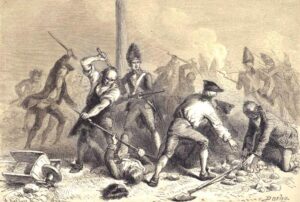
The civil war dimension manifested in widespread violence and persecution that extended far beyond battles with British soldiers. Patriots targeted Loyalists with tarring and feathering, property confiscations, banishments, and guerrilla skirmishes, particularly brutal in the southern colonies. Families were torn apart, as seen in the famous rift between Benjamin Franklin and his Loyalist son William. The British actively recruited and armed Loyalist militias, further escalating the internal conflict. For many, the Revolution was not just a fight for liberty from external tyranny but a savage struggle to suppress opposition at home.
A call for independence
The Commons hosted the moment New York formally heard of independence. On July 9, 1776, residents gathered there to listen to the Declaration of Independence read aloud with George Washington and Continental troops present. The relief did not last. New York’s harbor made it one of the best natural ports on the eastern seaboard, and the British wanted it as a base from which to supply their forces and split the rebellious colonies in two. They landed a massive invasion force on Staten Island that summer, beat Washington’s army in a string of battles around Brooklyn and Manhattan that August and September, and took the city in mid-September 1776.
New York then served as British military headquarters in North America for the rest of the war, and the Commons became the heart of that occupation. American prisoners were kept in the New Gaol and a new building called the Bridewell, and the provost marshal in charge of those prisons, William Cunningham, later confessed to starving roughly 2,000 prisoners and ordering the execution of more than 250 Continental soldiers on gallows behind the barracks. As fires destroyed housing and refugees poured in, a temporary shantytown known as “Canvas Town” grew up nearby, and rents in the city climbed by hundreds of percent under wartime pressure.
Further north, the war reached the bouweries too. After the British took control of the city in 1776, they expanded fortifications along the East River shoreline of the former Rutgers and De Lancey farms, treating the waterfront as a military asset. James De Lancey himself was not even in the country to see any of it. He had fled to England in the spring of 1775, and once rebellion looked likely, he and his family never came back.
Loyalist land, redrawn
That absence had consequences. De Lancey had sided with the Crown, and so had his cousin and namesake who commanded Loyalist troops during the war. Before the war he had already begun laying out streets across the southern part of his farm, even sketching a grand central square modeled loosely on London’s West End, bounded by what are now Eldridge, Essex, Hester, and Broome Streets. None of that survived the peace. Under the 1779 Act of Confiscation, the state seized the De Lancey estate and had it divided and sold off by commissioners appointed for that purpose, and a 1784 state law sped up the sale of forfeited Loyalist property generally. The grand square Delancey had envisioned was scrapped in favor of a plain street grid, which is why the neighborhood ended up looking nothing like the aristocratic plan he had drawn. The Rutgers family fared differently, having stayed loyal to the American side. After the British evacuated the city, Henry Rutgers inherited most of his father’s property, and his siblings received shares of the land as well.
Evacuation Day
The British departure did not come the moment the fighting ended. The Treaty of Paris was signed in September 1783, but New York, the last British stronghold on the American mainland, stayed occupied for months afterward while the British arranged ships to carry off thousands of soldiers and Loyalist refugees, including former slaves who had been promised their freedom for joining the Crown’s side during the war. The two sides finally agreed on a withdrawal date, and on the morning of November 25, 1783, the last British troops marched down out through the Battery to their waiting transports while Washington, Governor George Clinton, and a small body of Continental troops entered from the north and marched down The Bowery to meet them.
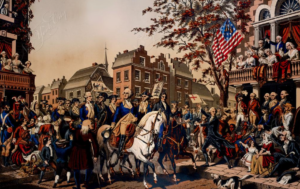
As a parting act of spite, the departing soldiers had greased the flagpole at the fort and cut its halyards so the British flag could not easily be lowered; a sailor named John Van Arsdale climbed it anyway, tore the flag down, and ran up the American one in its place. That evening Clinton hosted a public dinner for Washington and his officers at Fraunces Tavern, on Pearl and Broad Streets, where the company raised thirteen toasts, one for each former colony. A little over a week later, on December 4, Washington gathered his officers in the tavern’s Long Room to say goodbye in person before heading south to resign his military commission to Congress and retire, for the time being, to Mount Vernon. For much of the nineteenth century, New Yorkers marked November 25 as a major civic holiday, on par with the Fourth of July, with parades down Broadway and dinners at Fraunces Tavern, before it gradually faded from the calendar.
Washington returns as president
Six years later New York was again the place where Washington’s public life turned a corner, this time as the seat of the new federal government. He was inaugurated as the first President of the United States on April 30, 1789, at Federal Hall on Wall Street, on the site where the old City Hall had stood. A week before the inauguration he had already moved into a rented house at what was then 1 Cherry Street, on today’s Lower East Side, near the corner of Pearl and Cherry, on the eastern edge of the old De Lancey and Rutgers farmland not far from the East River.
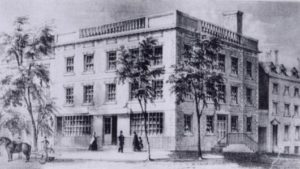
The house had been built in 1770 by a merchant named Walter Franklin and was owned at the time by Samuel Osgood; Congress leased it for $845 a year and spent thousands more furnishing it, turning part of the building into the equivalent of a presidential office. Washington’s neighbor at 5 Cherry Street was John Hancock, and the surrounding blocks were lined with similarly well-off households, a genteel pocket of the city that has nothing in common with the crowded, working-class Fourth Ward the same streets became within a few decades.
Washington’s household staff numbered about twenty, run by Samuel Fraunces, the former owner of Fraunces Tavern, and included several enslaved people Washington had brought north from Mount Vernon. The president lived on Cherry Street for about ten months, until February 1790, when the household relocated to a larger house, the Alexander Macomb mansion on lower Broadway near Bowling Green, with its own view of the Hudson. That stay was brief as well. Under the Residence Act of July 1790, the national capital moved to Philadelphia for a ten-year period while a permanent capital was built on the Potomac, and by the end of August 1790 Washington and his government had left New York for good.
What’s left of the colonial city
Almost nothing built before 1800 survives in this part of Manhattan. The Cherry Street house was torn down in 1856 to widen the road, decades before the construction of the Manhattan Bridge approach erased the rest of that block entirely, and only a small plaque under the bridge now marks roughly where it stood. What does survive is the street pattern laid over the old farms: Delancey Street and Orchard Street tracing the edges of a square that was never built, Rutgers Street marking land that passed out of that family’s hands generations ago, Stuyvesant Street running at its odd angle because it once cut straight through the middle of a bouwerie rather than following a grid that hadn’t been invented yet, and City Hall Park sitting on ground that was a colonial pasture, a Revolutionary-era prison yard, and the staging ground for the country’s first changeover of national power, all before any of the buildings now standing on it existed.