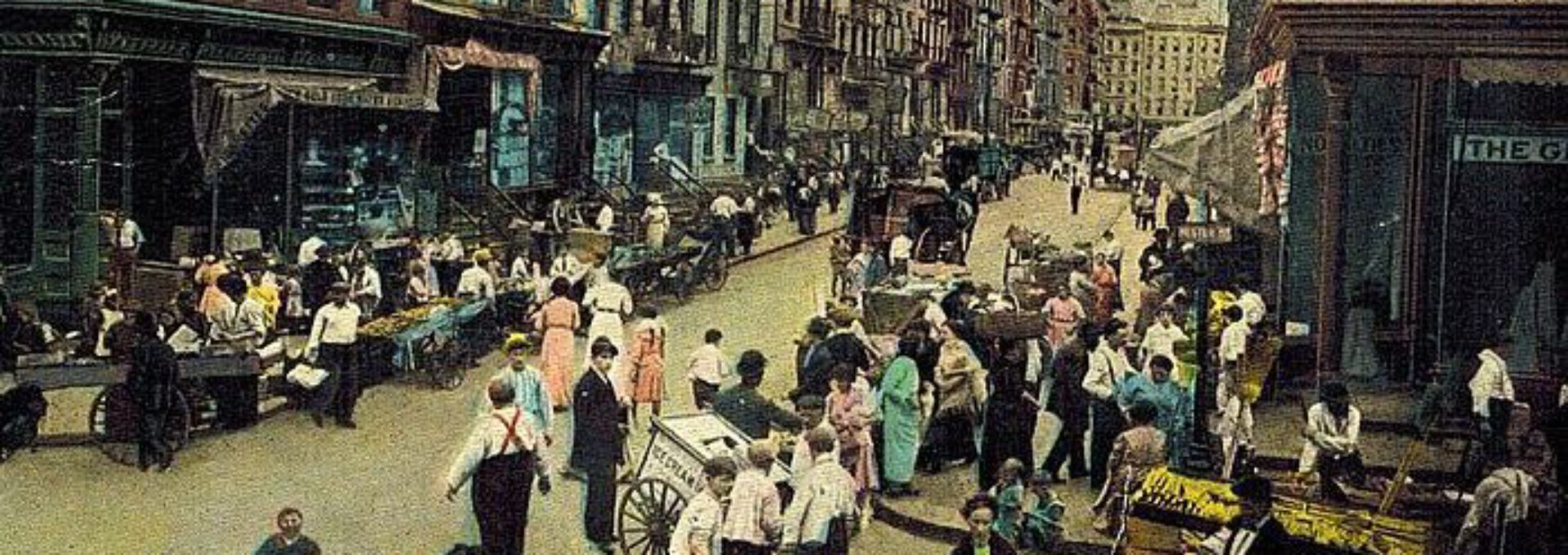
The Lower East Side is one of New York City’s most historic neighborhoods, but much of the neighborhood that immigrants, workers, and reformers once knew has disappeared.
Over the past two centuries, fires, redevelopment projects, urban renewal programs, street widenings, and changing economic conditions have erased thousands of buildings. Entire blocks have vanished, leaving behind only photographs, maps, and memories.
Understanding what was lost helps reveal how dramatically the neighborhood has changed.
The Original Five Points Neighborhood
Long before the Lower East Side became known as an immigrant district, much of the area was shaped by the remains of Collect Pond, a freshwater lake that once occupied a large section of Lower Manhattan.
After the pond was filled in the early nineteenth century, unstable ground conditions contributed to the development of the infamous Five Points neighborhood.
The original buildings of Five Points disappeared long ago, replaced by later construction and redevelopment projects.
The Immigrant Theater District
During the late nineteenth and early twentieth centuries, the Lower East Side was home to numerous theaters serving immigrant audiences.
Yiddish/Chinese/Italian/German/Irish theaters, music halls, and performance spaces attracted large crowds and played a central role in community life.
Most of these buildings have either been demolished or converted to other uses, leaving little visible evidence of what was once one of the most vibrant entertainment districts in America.
Early Synagogues
Thousands of immigrants established congregations throughout the Lower East Side.
While some historic synagogues survive today, many others were demolished as populations moved to other neighborhoods or as redevelopment transformed the area.
Their disappearance reflects larger changes in the city’s demographic landscape.
The Pushcart Markets
One of the most famous sights on the Lower East Side was not a single building but an entire streetscape.
Pushcart vendors once crowded neighborhood streets, creating enormous outdoor markets filled with food, clothing, and household goods.
These markets gradually disappeared as regulations changed and modern retail businesses expanded.
Today, photographs provide some of the best evidence of this lost world.
Historic Tenements
Although many tenement buildings remain, countless others have been demolished.
Some disappeared due to deteriorating conditions, while others were cleared for public housing projects, schools, road improvements, and new development.
Entire blocks that once housed immigrant families were transformed during the twentieth century.
Settlement Houses and Community Centers
The Lower East Side was home to numerous institutions dedicated to helping immigrant families adjust to life in America.
Settlement houses provided education, childcare, recreation, job training, and social services.
Many of the original facilities no longer exist, although their influence can still be felt in modern social service programs.
The Old Waterfront
Much of Manhattan’s eastern shoreline has changed dramatically since the nineteenth century.
Landfilling projects altered the coastline, expanded the city, and transformed the relationship between the neighborhood and the East River.
Buildings, piers, and maritime facilities that once stood at the water’s edge have largely disappeared.
Markets, Factories, and Workshops
Thousands of small businesses once operated throughout the Lower East Side.
Garment factories, workshops, bakeries, warehouses, and retail establishments filled neighborhood buildings.
As industries moved elsewhere and economic conditions changed, many of these structures were demolished or repurposed.
Urban Renewal and Public Housing
Few forces changed the Lower East Side more dramatically than twentieth-century urban renewal.
Large sections of the neighborhood were cleared to make way for public housing developments and other government-sponsored projects.
Supporters argued that these changes improved living conditions, while critics pointed to the destruction of historic buildings and established communities.
The debate continues to influence preservation discussions today.
Why Preservation Matters
The disappearance of so many historic buildings highlights the importance of preservation.
Every demolished building represents a lost opportunity to connect with the people who lived, worked, worshipped, and organized there.
By studying what was lost, visitors can better appreciate what remains and understand why the surviving historic landscape of the Lower East Side deserves protection.
The Lower East Side is not simply a collection of old buildings. It is a living record of immigration, community, struggle, and change. The buildings that survive today help tell stories that might otherwise be forgotten.
Interested in exploring the Lower East Side with an expert guide? Book a tour with Lower East Side History Project.