
Summary
The dismantling of New York City’s elevated trains marked a transformative moment in the city’s transit history. Once integral to Manhattan’s skyline and transportation network, elevated railroads became symbols of urban blight as modern subways and cars gained prominence.
The End of Elevated Trains in New York City: A Turning Point in Transit History
Elevated railroads, or “els,” once dominated Manhattan’s skyline, running along major avenues such as 2nd, 3rd, 6th, and 9th. By the 1930s, these iron giants were facing their twilight. Initially hailed as marvels of engineering when the first line opened in 1868, elevated trains became symbols of obsolescence and urban blight as the city grew and modernized. Their eventual dismantling marked a turning point in New York City’s transit history, reflecting shifting priorities and attitudes toward urban development.
The Rise and Decline of the Elevated Trains
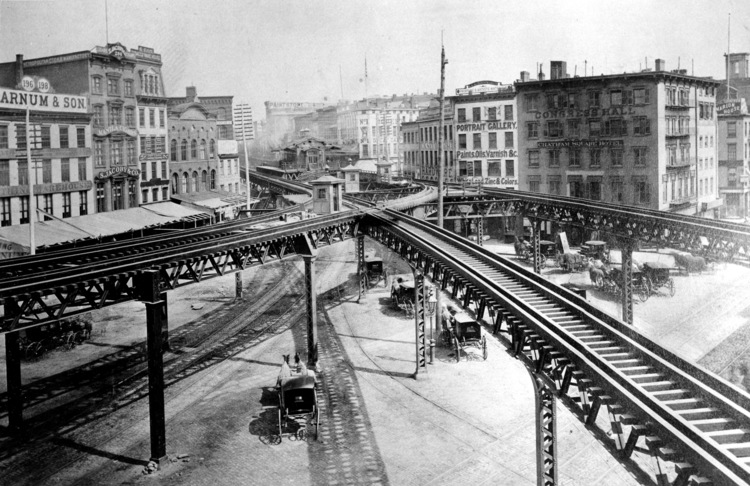
The els predated the subway by decades, providing much-needed transportation in a rapidly expanding city. They played a crucial role in the development of Manhattan and the surrounding boroughs, connecting areas that were otherwise difficult to access. However, their disadvantages became increasingly apparent as the city matured. As described by historian Robert Reed in The New York Elevated, the towering structures cast long shadows over streets, blocked sunlight, and created a cacophony of noise as trains thundered overhead. The sight of enormous iron girders bisecting avenues was both a marvel and an eyesore, with some residents lamenting the loss of open skies and natural light.
The noise was particularly grating. Trains clattered over iron tracks, their sounds amplified by the metal structures and surrounding buildings, creating a deafening roar that permeated neighborhoods. These issues led many to view the elevated trains as relics of a bygone era, unsuitable for a modern city striving for aesthetic and functional improvements.
Simultaneously, the city’s subway system, starting with the Interborough Rapid Transit (IRT) in 1904, was expanding underground. The Independent Subway System (IND), a municipally owned network, strategically placed new lines to compete with privately operated elevated routes. The contrast between the quiet, efficient subway and the loud, clunky els made the latter increasingly unpopular. This competition, coupled with financial difficulties faced by elevated operators, paved the way for the systematic removal of the els.
The Push for Demolition
Under Mayor Fiorello La Guardia, New York pursued a vision of modernization that included tearing down elevated lines. La Guardia, a champion of progress and urban renewal, often referred to the els as obstructions and nuisances. His administration, along with urban planner Robert Moses, prioritized automobiles and highways, believing that elevated trains hindered traffic flow and urban beauty. These priorities reflected a broader trend in urban planning during the mid-20th century, which often placed cars at the center of city development.
Organizations like the First Avenue Association, a consortium of property owners and real estate investors, were instrumental in pushing for the removal of elevated lines. They argued that the presence of the els devalued properties and deterred redevelopment. For these stakeholders, the demolition of the els represented an opportunity to revitalize neighborhoods, increase property values, and attract new investments.
The 6th Avenue el was the first to fall, with service ending in 1938 and demolition completed shortly thereafter. This demolition coincided with the construction of the 6th Avenue subway, providing a seamless transition for commuters. However, the fate of the 2nd Avenue el was more contentious. Long criticized for its noise and aesthetic drawbacks, the 2nd Avenue el was dismantled in 1942 without a subway replacement, leaving communities reliant on buses or more crowded subway lines. Plans for a 2nd Avenue subway had been discussed since the 1920s, but financial and political hurdles continually delayed construction, leaving a transit gap that persists to this day.
The End of an Era
By the mid-20th century, the remaining elevated lines in Manhattan—on 3rd and 9th Avenues—were also dismantled. Their removal marked the end of an era when elevated trains had defined the city’s transportation landscape. The decision to focus on subways and roadways instead of preserving or improving elevated lines reflected broader urban trends of the time. Cars and buses were seen as the future, while rail transit, particularly the outdated els, was considered part of the past.
The removal of elevated trains offered some immediate benefits, such as increased light, quieter streets, and improved aesthetics. Streets once overshadowed by iron girders became brighter and more inviting, with property owners anticipating a wave of redevelopment. However, the loss of transit capacity created challenges. The Lexington Avenue subway line, already one of the busiest in the city, became even more crowded, and bus routes struggled to absorb the displaced ridership. For neighborhoods like Yorkville and East Harlem, the absence of the 2nd Avenue el highlighted the need for reliable transit alternatives—a need that remains pressing to this day.
Impacts Beyond Manhattan
The dismantling of elevated trains also had ripple effects beyond Manhattan. The 2nd Avenue el, for example, provided a direct connection for commuters traveling from Queens via the Queensboro Bridge. Its removal disrupted these routes, forcing Queens residents to rely on alternative lines that were often overcrowded and inconvenient. Civic associations in Queens mounted vocal opposition to the el’s demolition, arguing that it was a vital transportation artery. Despite their efforts, economic pressures and wartime demands for scrap metal ultimately sealed the fate of the 2nd Avenue el.
The loss of elevated lines in Manhattan also shifted attention to the outer boroughs, where elevated trains continued to operate. Lines in the Bronx and Brooklyn, such as the 3rd Avenue el and the Myrtle Avenue el, faced similar pressures but persisted longer, serving as essential lifelines for their communities. Over time, however, these els too were dismantled as subways expanded and urban development priorities shifted.
A Legacy of Transformation
The dismantling of Manhattan’s elevated trains symbolizes a pivotal shift in New York City’s transportation priorities. While the decision aligned with the city’s aspirations for modernization, it also highlighted the complexities of urban planning, including the competing interests of residents, property owners, and policymakers.
IMAGE: the 3rd Avenue el at Chatham Square at The Bowery, c.1878. Courtesy of AP news.

Eric is a 4th generation Lower East Sider, professional NYC history author, movie & TV consultant, and founder of Lower East Side History Project.
I find this article to be wildly inaccurate and misrepresents the reason the Manhattan elevated lines were removed. They were not removed for the reasons presented here.
Developers were the primary reason the Manhattan els were demolished. Granted, subways replaced some of the el lines, but it was really Robert Moses who was also instrumental in eliminating these lines.
Numerous elevated lines still provide essential services in the three outer boroughs, so the role of greedy developers and Manhattan snobbery leave us with the shortcomings we have today, particularly on the East Side.
I mean, the article mentions all that. There were also residents and business owners who were in favor of demolition. Unfortunately, space is limited in a blog post, so we can only drop some seeds and hope readers take the time to go down the rabbit hole. Thanks for reading 🙂
I recall people in Brooklyn opposed the Ele removal as there business traffic declined as they thought.
The removal was political but some of it made sense. How come Chicago has their El?
Just a thought, but I could be wrong, as It could be that Chicago’s natural land mass isn’t stable enough to build for any underground transportation?
That’s not entirely true. There are underground lines that run from downtown to north, south, and northwest, before they come out of the ground at certain points, and become elevated.
In regards to ‘how come Chicago has their El?’ – being from Chicago I would say because there was never really a big complaint about it site-wise, or noise-wise, people just grew accustomed to it. Another factor is Chicago buildings have porch systems, where instead of an alley? The tracks ride between those areas, so both sides of the trains have the views of porches, and the porches have the views of the trains going by. Not a lot going on back there. It all kinda acts as a noise and site buffer. Manhattan doesn’t have that system of construction, and so I could understand why some people wanted the El’s gone from the main streets there. You have a lot of beautiful designed buildings and people want to see them. And who wants to hear a train going by when your were trying to watch tv? As a side note, in downtown Chicago, the area known as ‘The Loop’? All of the big building facades are facing the train tracks. It’s the only place you’ll find that, and then again all of those buildings are commercial buildings, so it doesn’t really matter.
From an aesthetic viewpoint, the ELs are unsightly and noisy. Granted I’ve only seen pictures of the Fulton Street El…but it would seem that building these things above the streets and between the existing buildings didn’t do much to increase the attractiveness of those streets/neighborhoods for residential use. Realizing that mass transit is intended to move massive numbers of people from point A to point B…still…it would seem that the EL trains caused the decline in the areas of the city where they were located.
Agreed. They were unsightly and noisy and cast entire districts into the dark — but a necessity. However, think about how it was a burgeoning and very utilitarian city at the time. Perhaps aesthetics and longevity were an afterthought in most public works projects.
It is an interesting discussion. I would also add that we have to consider the ‘character factor’ of city/city design. A lot of old beautifully designed buildings, many that still exist to this day, they gave the city character, which also built peoples character. There is a certain amount of character in trains that run through cities to. You add the traffic, and the many, many faces of people who go out among the the streets, neighborhoods of all kinds, along with the characters of people, and what you end up with is something that builds peoples characters in my opinion. I happen to think all of this square and glass stuff that has been growing in the city has taken a lot of character away from the city. This is particularly true when you think about the things cities don’t have anymore, like phone booths, police boxes, salt boxes, the beat cops, fluorescent signs, white light street lamps, and I mean for crying out loud ‘stick ball’! All of that built the psyche of people, when people didn’t even realize it. It built our characters. Notice how the younger generations don’t have much character, other than being adored by themselves? In other words, the city is getting rid of its character. I say it’s a bad move.