
Summary
The story of Slavic New York is not a single story. It is dozens of them, layered on top of one another: Polish families fleeing Imperial Russia at the turn of the twentieth century; Ukrainian refugees arriving with almost nothing after World War II; Soviet Jews building an unlikely new shtetl in South Brooklyn; Czechs and Slovaks who found each other in Yorkville; Serbs and Croats and Bulgarians who came looking for factory work and stayed for generations. Together, they have left their mark on this city in churches, in language schools, in the names of streets, and above all, in food.
Wars, famines, generations of political turmoil… Slavic people have endured some of the worst hardships in modern human history. National boundaries have been drawn and redrawn over and over again. By the late 19th century, America gave some reprieve from the disorder, as our doors opened to welcome many of these European immigrants.
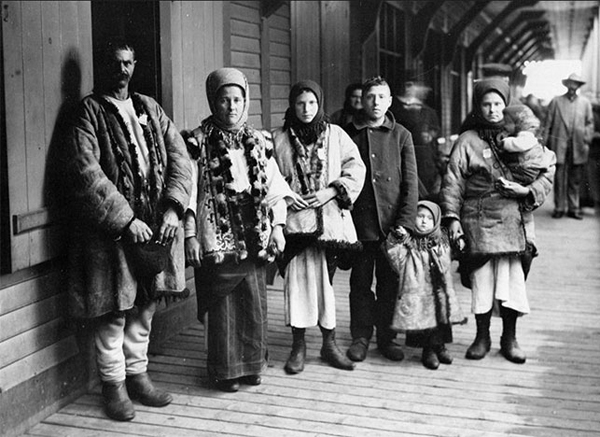
My Russian and Ukrainian family started immigrating to NYC in 1909. What they left behind, nobody knows. There are no traces left of most of the villages they came (escaped) from. It is a similar story with most people of Slavic ancestry living here in the United States.
The First Great Wave: Before World War I
One of the largest influxes of Slavic people into the United States came in the three decades before World War I, a wave comparable in scale to the earlier tides of Irish and German immigration. The 1900s alone saw nearly nine million arrivals pass through American ports, and immigrants from Slavic regions accounted for a significant share of that total. By the time the guns of the Western Front fell silent in 1918, several million Americans of Slavic origin had put down roots across the America.
Most of these immigrants came from what were then the great multi-ethnic empires of Central and Eastern Europe: the Russian Empire, the Austro-Hungarian Empire, and parts of the Balkans under Ottoman influence. Ordinary national identities (Polish, Ukrainian, Czech, Slovak, Croatian, Serbian, Slovenian, Bulgarian) were real to the people who carried them, even if the borders of states did not always reflect that reality. A man boarding a ship in Hamburg might list his birthplace as “Austria” and his language as “Ruthenian,” and arrive at Ellis Island to be registered as Russian.
They came for economic reasons, above all. Most were rural people, peasants and small farmers, who saw little future in the Old World’s saturated land markets, wars and rigid social hierarchies. New York was often just a transit point, as many moved on to steel mills in Pittsburgh, coal mines in Pennsylvania, and factories in Chicago.
By the turn of the century, the Lower East Side of Manhattan teemed with Eastern European immigrants of every stripe. Romanian Jews lived beside Orthodox Ukrainians; Polish Catholics shared tenements with Slovak Lutherans. The district developed distinct micro-neighborhoods, including early clusters of Poles, Russians, and Ukrainians who worshipped in the basement of St. Brigid’s Roman Catholic Church on Avenue B before they had their own sanctuaries.
The Lower East Side’s “Little Ukraine”
Of all Slavic communities in New York, the Ukrainian one has perhaps the most visible and enduring presence in lower Manhattan. Ukrainian immigration to the area that would become the “East Village” began in the 1870s and intensified through the 1910s, with early settlers arriving primarily from the Austro-Hungarian province of Galicia, which is today western Ukraine. They came with their language, catholic faith, and their folk traditions, and they built institutions around them.
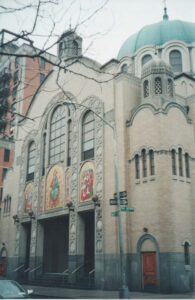
The spiritual anchor of the community, St. George Ukrainian Catholic Church, was established in 1905 at 30 East 7th Street. The church that stands today is a striking Byzantine-style building completed in 1978 that replaced the original structure and remains a landmark of the neighborhood. Around it, a whole world: Ukrainian-language schools, mutual aid societies, credit unions, and eventually an entire cultural infrastructure that made Little Ukraine, at its postwar peak, one of the most vital Ukrainian communities anywhere outside of Ukraine itself.
That peak came after World War II, when tens of thousands of displaced persons and political refugees, Ukrainians fleeing both Nazi occupation and Soviet repression, settled across New York, with the East Village as their densest and most visible concentration. The community was so tightly knit that longtime residents might have at one time considered non-Ukrainian New Yorkers out of place.
“Little Poland”: Greenpoint, Ridgewood and Beyond
Polish immigration to New York followed a similar arc to the Ukrainian one, but its center of gravity shifted to Brooklyn. During the industrial boom of the 1880s through 1920s, Polish immigrants established themselves in Greenpoint, a neighborhood that came to be called “Little Poland,” as well as in Queens neighborhoods like Ridgewood, Maspeth, and Middle Village. At its height, the Polish diaspora in New York numbered in the hundreds of thousands.
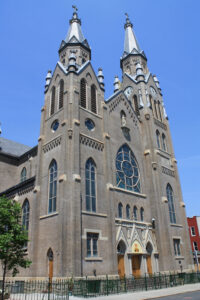
Greenpoint’s Polish character was shaped by successive waves of migration. The earliest arrivals came seeking industrial work; later waves included refugees from the violence of World War I, when Poland’s territory was a battlefield between the Russian, German, and Austro-Hungarian Empires. Then came survivors of World War II, and later, in the 1980s, a new generation fleeing economic hardship and political repression under Communist rule. Each wave renewed and reshaped the community.
The infrastructure of Polish Greenpoint was impressive: the neighborhood supported Polish-language Catholic parishes, schools, fraternal organizations, newspapers, and shops. St. Stanislaus Kostka Church on Humboldt Street, home to the largest Polish Catholic congregation in Brooklyn, drew Cardinal Karol Wojtyła himself during a 1969 visit to the city, years before he became Pope John Paul II. Two bridges crossing Newtown Creek carry the names of Polish-American heroes of the American Revolution: the Pulaski and the Kosciuszko, both named for commanders who fought alongside George Washington.
By the early 2000s, political changes in post-Communist Poland had slowed immigration and prompted some return migration, and the Polish-born population of New York dropped to around 60,000. Yet Greenpoint’s Polish identity has proven remarkably durable. A combination of legacy institutions, long-established businesses, and continued if smaller flows of new arrivals has kept “Little Poland” recognizable even as gentrification reshapes the neighborhood around it.
“Little Odessa”: Brighton Beach and the Soviet Jewish Exodus
In the mid-1970s, a remarkable transformation began at the far southern end of Brooklyn. Brighton Beach, once a glamorous seaside resort that had fallen into decline with its older Jewish residents struggling amid rising crime and neighborhood disinvestment, became the destination of a new wave of Soviet immigrants. Mostly Ashkenazi Jews from Ukraine and Russia, they arrived after the Soviet Union loosened its emigration restrictions, often with little money and less English, and settled into the available apartments with the help of resettlement agencies like NYANA (New York Association for New Americans). Between 1975 and 1980, roughly forty thousand Soviet Jewish émigrés arrived in New York City, many of whom made Brighton Beach their home.
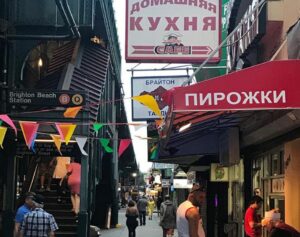
The neighborhood earned the nickname “Little Odessa” after the port city on the Black Sea, a city with a historically large Jewish population and a deep cultural resonance for many of the new arrivals. Along Brighton Beach Avenue, which runs beneath the elevated B and Q subway lines, a whole parallel city emerged. Russian-language grocery stores stocked black bread, pickled vegetables, smoked fish, and caviar. Restaurants served pelmeni, borscht, Chicken Kiev, and kasha. Cabarets and nightclubs hosted performers from across the former Soviet republics. Bookstores sold Russian literature. The boulevard felt, to those who walked it, like a piece of another world transplanted whole.
After the Soviet Union collapsed in 1991, a new wave of immigration followed, this one more ethnically diverse, including not just Russian and Ukrainian Jews but ethnic Russians, Christians, and immigrants from Georgia, Armenia, and Central Asia, all bound together by the Russian language. New York City became, and remains, home to the largest Russian-speaking population in the Western Hemisphere. The community’s cultural reach extended well beyond Brighton Beach: Russian-speaking New Yorkers also concentrated in Rego Park and Forest Hills in Queens, Washington Heights in Manhattan, and as incomes rose, in suburban communities across New Jersey.
Other Slavic Voices: Czechs, Slovaks, Serbs, Croats, and More
The Polish, Ukrainian, and Russian communities are the largest and most visible of New York’s Slavic populations, but the city has long housed a remarkable diversity of other Slavic groups as well. Yorkville, on the Upper East Side, was for much of the twentieth century a multi-ethnic Eastern European enclave where Czechs, Slovaks, and Hungarians lived alongside Germans. Czech and Slovak immigrants established churches, fraternal halls, and social clubs in the neighborhood, and the area supported a lively calendar of Eastern European cultural events.
Serbian and Croatian immigrants settled in pockets throughout the city, particularly in the Bronx and Queens. The South Slavic diaspora, which also included Slovenians and Bulgarians, built its own network of Orthodox and Catholic parishes, national homes, and social organizations. Many of these communities were politically divided, as the upheavals of Yugoslavia, from World War II through the wars of the 1990s, sent successive waves of refugees to New York, each carrying their own traditions and allegiances.
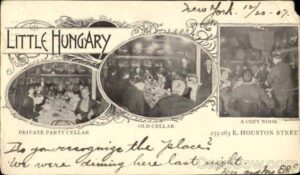
The Lower East Side itself was a mosaic of these smaller communities. Around East Houston Street at the turn of the last century, alongside the Hungarian enclave known as Goulash Row, there were separate micro-neighborhoods for Poles, Germans, and various other Eastern Europeans, each clustered around their own church, social club, or delicatessen. These were not just ethnic neighborhoods. They were survival networks, translating an incomprehensible new city into something navigable.
Lasting contributions of Slavic New York
One of the most enduring contributions of Slavic New York is its cultural calendar. Across the boroughs, communities have kept alive festivals and observances that trace their origins back centuries.
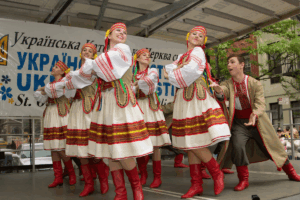
The Annual Ukrainian Festival on East 7th Street, held on the weekend closest to May 17, is one of the few remaining authentic New York street fairs, a place where you can hear traditional kobza music, watch folk dancers in embroidered vyshyvanka shirts, and buy pysanky, the elaborately decorated Easter eggs that are among the most distinctive forms of Ukrainian folk art. St. George’s Ukrainian Catholic Church has sponsored the festival since 1976, and it draws Ukrainians from across the region.
The Polish community holds its own festivals and cultural events, including the annual Pulaski Day Parade, one of the oldest ethnic parades in New York City, held every October in honor of Casimir Pulaski, the Polish-born Revolutionary War general. The parade is a reminder that Slavic Americans have been part of this country’s story since its founding.
Brighton Beach holds its own annual Brighton Jubilee, celebrating the area’s Russian-speaking heritage with music, food, and community. The Brighton Ballet Theater, founded in 1991, has trained ballet and folk dancers from Russia, Ukraine, and Georgia and is considered one of the premier Russian ballet schools in the country.
Slavic Orthodox and Greek Catholic traditions shape the ritual calendar of these communities which are in many ways invisible to outsiders. In Orthodox communities, Christmas is celebrated in January following the Julian calendar, while Polish Catholics and others observe it in December. Easter (Paskha in Russian and Ukrainian) is the most important holiday of the year, preceded by a long Lenten fast and celebrated with special breads, blessed baskets of food, and midnight church services that can last until dawn. Coloring eggs for Easter is common across Slavic cultures; the Ukrainian pysanka tradition elevates this into an art form. And Maslenitsa, sometimes compared to Mardi Gras, is marked with blini, thin buckwheat pancakes eaten with sour cream, butter, and caviar.
The Table: Slavic Food in New York City
If there is one dimension of Slavic culture that has traveled most successfully into the broader New York City consciousness, it is food. The pierogi, a half-moon dumpling stuffed with potato and cheese, sauerkraut and mushroom, or meat, is the iconic dish of the Ukrainian and Polish communities, and has long since crossed over into the city’s general culinary vocabulary. Borscht, the beet soup that is perhaps the most recognizable of all Eastern European dishes, comes in Ukrainian, Russian, Polish, and Jewish variations, each slightly different in technique and garnish. In the Russian tradition it is typically served with a generous dollop of smetana, or sour cream, and a chunk of black rye bread. In Ukrainian homes, it might include white beans or chunks of meat, and is considered serious winter sustenance rather than mere soup.
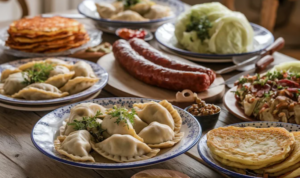
Brighton Beach Avenue is a food lover’s education in the breadth of the former Soviet world. Bakeries sell pirozhki, small baked or fried buns stuffed with cabbage, potato, or meat. Smokehouses offer cured fish and sausage in varieties that have no English names. Delicatessens stock rows of pickled vegetables, jars of preserved mushrooms, and tins of caviar in every price range. Georgian restaurants (a reminder that “Slavic” and “Russian-speaking” are not the same thing) serve khachapuri, the cheese-filled bread that has become one of the most sought-after dishes in the entire city.
Stuffed cabbage (holubtsi in Ukrainian, gołąbki in Polish) is another cross-cultural staple, appearing on the menus of diners from the East Village to Greenpoint. Blintzes, thin crepes filled with sweet cheese and served with fruit preserves, bridge the gap between Slavic and Jewish culinary traditions. Kasha, buckwheat groats, nutty and filling, appears in many guises: as a side dish, as a stuffing, or as the base of the Jewish-American comfort food kasha varnishkes, a dish that arrived in New York’s Lower East Side from the Pale of Settlement.
Hidden Gems (according to the author)
Here are a few personal favorites that may not be on everybody’s radar:
- Streecha (Ukrainian)
Originally catering to the churchgoers across the street, this basement-level, no frills restaurant didn’t even have signage until recently. It felt like a community secret. It offers cafeteria-style, communal seating and some of the most authentic fare made fresh on site.
33 E 7th St, New York, NY 10003 - Kubus (Polish)
Beyond everything you need from a Polish deli (meats, cheeses, breads, imported items, etc.), they serve awesome hot food at a very reasonable price. Just note: there is no seating, but you can sit on a bench in the cemetery across the street.
65-27 Grand Ave, Queens, NY 11378 - Stolovaya (Russian)
Borscht, kebabs, dumplings, even rabbit. This is as authentic as you can get. Another no-frills option with great food and friendly staff that will help you pick items from the menu that you may be unfamiliar with (some have no English names).
813 Avenue U, Brooklyn, NY 11223 - Cheburechnaya (Kosher)
Though not technically or entirely Slavic, this Uzbek and Bukharan Jewish restaurant offers traditional Russian, Central Asian, and Soviet-style cooking. As a bonus, around the corner on Queens Blvd is NetCost Market, which offers a huge selection of imported Russian, Ukrainian, Georgian, and Belarusian goods, as well as prepared hot food, a deli and a bakery.
92-09 63rd Dr, Queens, NY 11374
A Living History
Gentrification has eroded many of the physical traces of these communities. The Ukrainian candy stores, the Polish butchers, the Russian bookshops beneath the elevated train have not all survived. But the institutions that remain carry an enormous amount of meaning to their respective communities and the greater New York City tapestry.
What are some of your favorite Slavic restaurants, shops and neighborhoods? Leave a comment!
[Featured image: Ukrainian immigrants arrive to America, courtesy of vilni-media.com]

Eric is a 4th generation Lower East Sider, professional NYC history author, movie & TV consultant, and founder of Lower East Side History Project.
My fathers family came from polish galacia at the turn of the century and spent a few decades in Brooklyn/Queens before finding mill work out in the Pittsburgh area I’ve never been to nyc but would love to trace my roots one day and visit all these amazing places